Yes, but not by much. The core steps — cleanse, treat, moisturise — stay the same morning and night. The real differences are usually just one thing: sunscreen in the morning, and sometimes a stronger active (like a retinoid) at night, because some ingredients break down in sunlight or make skin more sun-sensitive.
Do mornings and nights really need different products?
Not entirely different — mostly the same routine with small, purposeful swaps. A basic structure of cleanser, treatment, moisturiser works both times of day. The main additions are sunscreen for daytime and, for some people, a retinoid or stronger exfoliating acid at night instead of during the day.
Beyond that split, there’s no rule saying skin needs a dramatically different set of products depending on the clock. A lot of skincare marketing implies otherwise, but the basics of what skin needs — cleaning, some active ingredient if one is being used, and moisturiser to support the skin barrier — don’t change with the sun going down.
Why does sunscreen belong in the morning specifically?
Sunscreen only works while it’s on the skin and light is hitting it, so it makes sense as a daytime step rather than a nighttime one. Applying it at night doesn’t do anything useful, since there’s no UV exposure to block while asleep.
This matters more than it might seem for anyone using acne treatments. Several common ingredients — including some retinoids and certain exfoliating acids — can make skin more reactive to sun. That doesn’t mean daytime activity needs to stop; it means a broad-spectrum sunscreen in the morning routine is worth being consistent about, particularly on days when one of those actives was used the night before.
Why do some actives get saved for night?
Certain ingredients are less stable in sunlight or are more likely to increase sun sensitivity, so they’re often applied at night as a matter of practicality rather than strict necessity. Retinoids are the most commonly mentioned example.
Some retinoid formulas do degrade with UV exposure, and separately, retinoid use can leave skin more prone to sunburn. Using one at night avoids both issues without any real downside, since skin repairs and turns over overnight regardless of when a product went on.
Stronger exfoliating acids (higher-strength AHAs or BHAs) get grouped into night routines for similar reasons — mostly caution around sun sensitivity rather than the ingredient itself being “wrong” for daytime. A pharmacist or dermatologist can speak to a specific product’s instructions if that’s ever unclear, since formulations vary.
Does cleansing need to be different morning versus night?
Not fundamentally — the same gentle cleanser can usually be used both times. The main argument for cleansing at night is removing the day’s build-up of sunscreen, oil and any product residue before sleep; in the morning, it’s more about clearing overnight oil rather than “cleaning off dirt.”
Some people prefer a quick rinse with water only in the morning if their skin doesn’t feel like it needs a full cleanse, and save the more thorough cleanse for night. Either approach is reasonable. For more on how often washing actually helps versus doesn’t, there’s a dedicated look at how often acne-prone skin should be washed, since over-washing can irritate skin just as much as under-washing.
Does moisturiser need to change between routines?
Not usually — a moisturiser can stay the same in both routines unless it contains SPF, in which case it typically only makes sense for daytime. Moisturising at night still matters, even for oily or acne-prone skin, because barrier support doesn’t stop mattering after dark.
Anyone unsure whether moisturiser is even necessary alongside acne treatments can find more detail in the piece on whether acne-prone skin still needs moisturiser — short answer, it generally does, especially when actives are drying skin out.
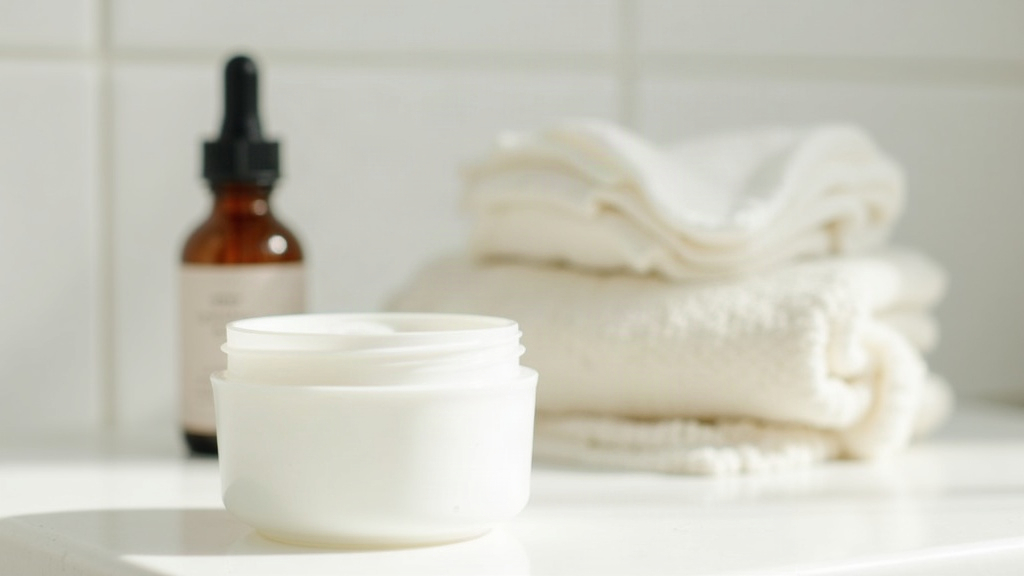
What does a simple version of this actually look like?
A workable starting point is roughly: cleanse, treat (if using an active), moisturise, sunscreen in the morning; and cleanse, treat (if using a different or stronger active), moisturise at night. Not every step needs a product every single day, and simpler is often more sustainable than complicated.
For a fuller breakdown of what a basic day-and-night structure can look like without excess steps, the article on what a simple acne routine actually looks like goes through it step by step. It’s worth noting that piling on more products, whether morning or night, isn’t the same as piling on results — more steps mean more chances for irritation, not necessarily better skin.
Is it ever a problem to use the same routine both times?
Using an identical routine morning and night isn’t inherently harmful, apart from the sunscreen gap, which is the one piece that genuinely doesn’t translate across both times of day. Skipping sunscreen in the morning is the main way a “same routine both times” approach falls short.
Everything else is more about preference and what skin tolerates than a hard rule. Some people do fine with one gentle cleanser and one moisturiser used identically twice a day, with an active layered in once, at whichever time makes sense for that specific ingredient’s instructions.
What about introducing new products into a two-part routine?
New actives are still worth introducing one at a time regardless of whether they’re going into a morning or night slot, so that any reaction can be traced back to a specific product rather than guessed at. This matters more, not less, once a routine has multiple steps split across two times of day.
The reasoning behind that approach — and why it saves a lot of frustration later — is covered in why introducing one product at a time matters. Patch testing before a new product goes anywhere near the face is worth doing too; the how-to is in the guide on what patch testing is and how to do it.
It’s also worth expecting that a new product, especially an active used at night, might take a while before any change is noticeable — and that some initial dryness, stinging or peeling can happen before things settle, which is different from a product actively harming skin. The difference between temporary purging and a genuine bad reaction is explained in skin purging versus a bad reaction, and general timing expectations are covered in how long to wait before judging a new skincare product.
When is it worth asking a professional instead of adjusting alone?
If acne is painful, cystic, leaving marks, spreading, or affecting how someone feels day to day, that’s a reasonable point to bring it to a doctor or dermatologist rather than keep testing routines alone. Getting a professional opinion early is a normal step, not an overreaction, and it can save a lot of trial and error.
A doctor can also speak to whether a stronger option — including prescription-strength retinoids, oral antibiotics, hormonal treatments, or isotretinoin in more persistent cases — might be worth discussing, since these require proper supervision and monitoring and aren’t something to source or dose independently. None of that replaces a basic morning-and-night routine; it usually sits alongside one.
For background on how acne actually forms in skin in the first place, which can make all of this feel less arbitrary, the Acne Basics archive is a reasonable place to start, and the Skincare Routines archive covers more on building a routine that fits a specific skin type and tolerance level rather than a generic template.
Acne Cut publishes general information about skin, not medical advice. We are writers and researchers, not dermatologists, doctors or pharmacists. Acne varies enormously from person to person, and what suits one person’s skin can irritate another’s. If your acne is painful, scarring, getting worse, or affecting how you feel day to day, speak to a doctor or a dermatologist — that is a normal thing to do and it is what they are there for.